
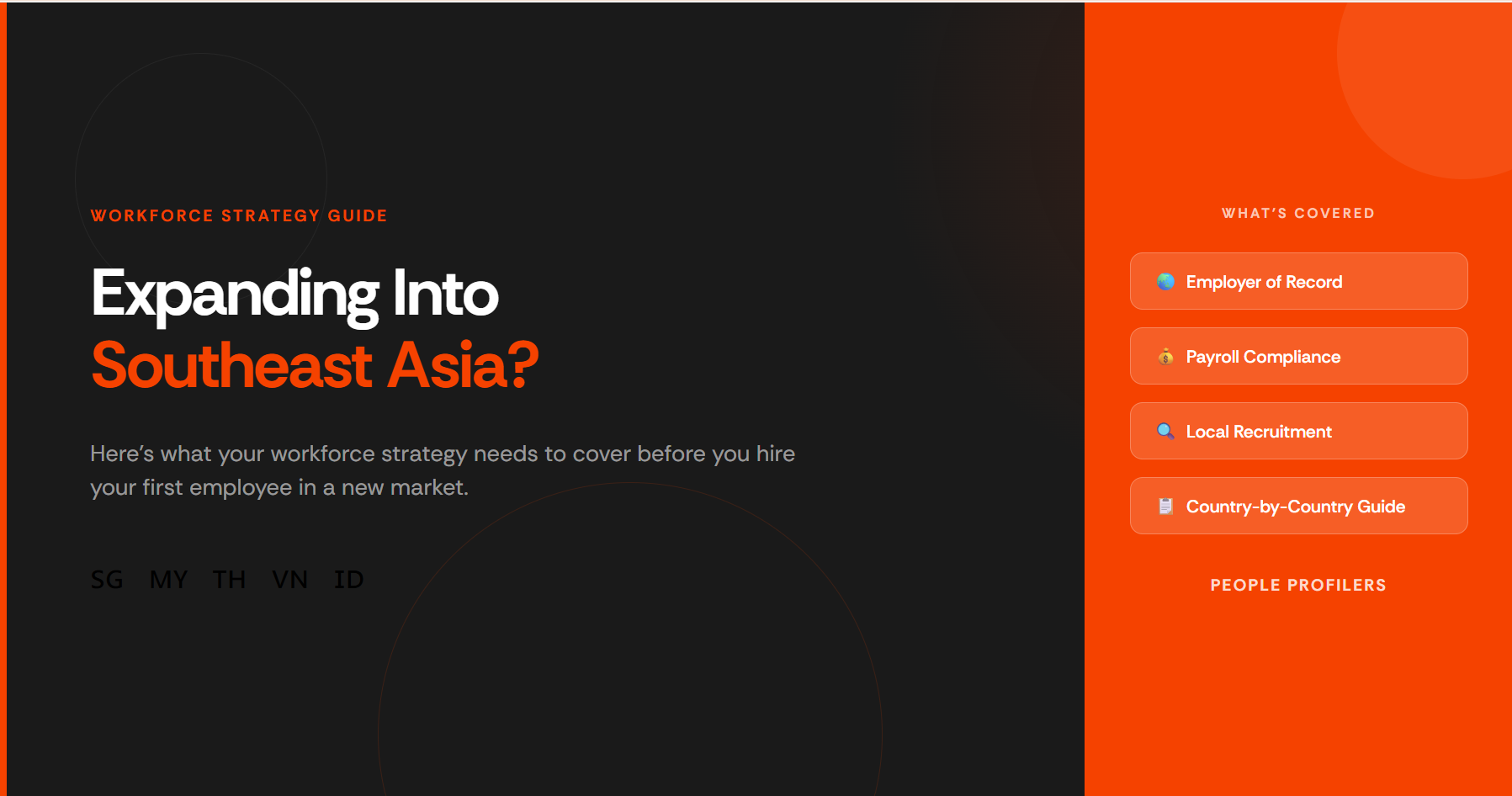
How to Expand Your Business Into Southeast Asia: Workforce Strategies That Actually Work
Global expansion today requires more than a market entry plan. Businesses moving into Southeast Asia face a complex web of employment laws, payroll regulations, work permit requirements, and cultural expectations — all of which vary significantly from country to country.
The good news: with the right workforce strategy and the right partners, expansion across Singapore, Malaysia, Thailand, Vietnam, and Indonesia doesn’t have to be overwhelming. It can be the most strategic growth decision your business makes.
Why Southeast Asia? The Business Case
Southeast Asia is home to over 680 million people, a rapidly growing middle class, and some of the world’s fastest-growing economies. For businesses looking to diversify supply chains, access regional talent, or enter new consumer markets, the region offers compelling opportunities:
- Singapore: Regional HQ hub, strong legal framework, English-speaking workforce, gateway to ASEAN
- Malaysia: Cost-competitive talent pool, strong bilingual workforce, business-friendly environment
- Thailand: Manufacturing hub, growing tech sector, skilled workforce across Bangkok and key provinces
- Vietnam: One of Asia’s fastest-growing economies, young workforce, strong in manufacturing and tech
- Indonesia: Largest economy in Southeast Asia, 270+ million population, massive domestic market
The Biggest Challenges of Regional Workforce Expansion
Most companies underestimate how different employment rules are across each ASEAN country. What works in Singapore will not automatically work in Vietnam or Indonesia. Common challenges include:
- Setting up local legal entities in each country — which can take months and significant capital
- Navigating different statutory contribution schemes (EPF in Malaysia, BPJS in Indonesia, Social Security in Thailand)
- Managing multi-currency payroll compliantly across jurisdictions
- Understanding local termination rules, leave entitlements, and employment contracts
- Finding and hiring local talent quickly without an established employer brand in-market
How Employer of Record (EOR) Solves the Entity Problem
An Employer of Record (EOR) is a third-party company that legally employs your staff in a target country on your behalf. You direct the work; the EOR handles everything else — contracts, payroll, statutory contributions, tax filings, and compliance.
For businesses testing a new market or hiring a small team quickly, EOR is far faster and more cost-effective than setting up a full legal entity. You can be operational within days rather than months.
People Profilers operates EOR services across Singapore, Malaysia, Thailand, Vietnam, and Indonesia — giving businesses a single trusted partner for regional workforce management.
Payroll Outsourcing: Staying Compliant Without the Headache
Even for companies with established entities in Southeast Asia, multi-country payroll remains one of the most operationally complex tasks. Each country has its own:
- Payroll cycle and statutory contribution deadlines
- Tax filing requirements and withholding rules
- Leave accrual and overtime calculation methods
- Year-end reporting obligations
Outsourcing payroll to a regional specialist eliminates compliance risk, reduces internal HR workload, and ensures your employees are paid accurately and on time — regardless of which country they’re in.
Recruitment: Finding the Right Talent in Unfamiliar Markets
Hiring in a new market is not just about posting a job ad. Local talent pools have different expectations around compensation, career progression, and employer branding. In competitive markets like Singapore and Malaysia, the best candidates are often passive — they’re employed and not actively looking.
Working with a local recruitment partner who understands the market, speaks the language, and has an established talent network dramatically reduces your time-to-hire and improves the quality of candidates.
A Quick Guide: What to Know Before You Hire in Each Country
Singapore
Strong employment framework under the Employment Act. Key contributions: CPF (Central Provident Fund). Work passes required for foreign hires (EP, S Pass, Work Permit). Singapore is the natural HQ base for regional operations.
Malaysia
Employment Act 1955 governs most employees. Key contributions: EPF, SOCSO, EIS. Minimum wage applies nationally. Strong bilingual talent pool across Kuala Lumpur and major cities.
Thailand
Labour Protection Act governs employment. Social Security Fund contributions required for both employer and employee. Work permits required for foreign nationals. Bangkok is the main talent hub.
Vietnam
Labour Code 2019 governs employment. Mandatory contributions to Social Insurance, Health Insurance, and Unemployment Insurance. Labour leasing licence required for staffing services. Ho Chi Minh City and Hanoi are primary talent hubs.
Indonesia
Manpower Law No. 13/2003 and its amendments govern employment. Mandatory BPJS Kesehatan (health) and BPJS Ketenagakerjaan (employment) contributions. Jakarta is the primary business hub.
Ready to Expand Into Southeast Asia?
People Profilers has been supporting regional workforce expansion for over 20 years. Whether you need EOR, payroll outsourcing, recruitment, or a full end-to-end HR solution, our teams across Singapore, Malaysia, Thailand, Vietnam, and Indonesia are ready to help.
Talk to us today about your expansion plans.